That Old Nokia Tower Building Game: Tower Bloxx
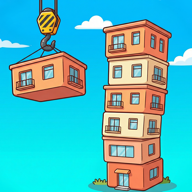
You remember a crane swinging a floor of a building back and forth, one button to let go, and a tower that wobbled more the higher it got. Probably on a phone with a keypad. This post pins down which game that was, what happened to it, and what plays the same way now, including the tower stacking game I make, Tower Rush.
To be clear up front: Tower Rush is not that game and has nothing to do with the people who made it. It borrows the same crane-and-drop idea, and I’ll say plainly where they differ.
The game you’re thinking of is Tower Bloxx
The old Nokia tower building game was almost certainly Tower Bloxx, made by Digital Chocolate’s Helsinki studio. According to Wikipedia’s article on it, it was released to mobile phone carriers in December 2005, and went on to J2ME, BREW, Flash in the browser, DoJa, Windows Mobile, BlackBerry and Android. The same article says it was also known as City Bloxx.
The Nokia connection is mostly that second name. Pocket Gamer’s review of the Nokia 7500 Prism lists City Bloxx among the games preloaded on that phone, next to Snake III and Sudoku, and calls it a variant on Digital Chocolate’s Tower Bloxx. Wikipedia says City Bloxx was preloaded on some Nokia phones and that other makers, LG among them, preloaded the game too. I haven’t found a reliable full list of which Nokia models had it, so if yours isn’t the 7500, I can’t confirm it from here.
How Tower Bloxx played
The best description comes from the people who made it. In Digital Chocolate’s postmortem on Game Developer, written in 2006, Mikko Kodisoja explains the action mode: you build a skyscraper by dropping floors from a crane, it’s windy so the floors swing (quite a lot higher up), and timing is everything. Drop a floor too close to the edge and the tower might fall, sometimes taking finished floors with it. Too many bad drops and construction is called off. You finish a tower by dropping a roof on it.
How precisely and how quickly you stacked decided how many residents (the “Tower Toons”) moved in. The same postmortem says the whole thing started as a throwaway prototype called “drop the box”, and that a designer and programmer spent three weeks iterating on the swing and drop physics alone before anyone was happy with it.
Quick game and city mode
Wikipedia describes two modes. In the quick game you build the tallest tower you can, and three missed drops end it. In city mode, finished towers go onto a city grid, and that’s where the puzzle comes in. The postmortem lists four tower types, 10, 20, 30 and 40 floors, each with a placement rule: 10-floor towers go anywhere, while a 40-floor tower needs every other type around it.
City Bloxx, Deluxe and the rest of the series
Per Wikipedia, Tower Bloxx turned into a series. Tower Bloxx Deluxe came out in 2008, including on PC as a CD-ROM, and on Xbox Live Arcade in October 2009. A Facebook version appeared in 2007, and later entries included Tower Bloxx: New York and Tower Bloxx 6-D.
So if you remember it on a PC or a console rather than a phone, you’re probably thinking of Deluxe.
Can you still play Tower Bloxx online?
Not easily, and not officially as far as I can find. The keypad-phone versions were Java (J2ME) games, and the browser version was Flash. A 2007 GIGAZINE write-up pointed readers to a playable copy on Newgrounds, with the space key to drop and both Build City and Quick Game modes.
Flash itself is finished. Adobe discontinued Flash Player on December 31, 2020, and from January 12, 2021, Flash Player refuses to play Flash content. Some sites now run old Flash games through Ruffle, an open-source Flash emulator, but whether a given copy of Tower Bloxx works in it, and whether that copy was ever an official release, is something I can’t vouch for.
You’ll find sites offering Tower Bloxx JAR, APK or ROM downloads. I’m not linking any. They’re unofficial, and a random download from them is not something I’d run.
Why the crane-and-drop mechanic still works
The postmortem explains it well: the team wanted the core so good it could keep people playing on its own, without the city mode carrying it. One button means anyone can play in a second. The swing means every drop is a small timing problem, and the tower’s memory of your mistakes means a sloppy drop now costs you later. That combination, instant to learn and slow to master, is why the idea outlived the phones it shipped on.
Games like Tower Bloxx today
Stack, on phones
The best-known modern relative is Stack by Ketchapp. Its App Store listing shows it as free with in-app purchases and ads. It isn’t a crane game: a review from Children and Media Australia describes blocks sliding over the tower, a tap to place each one, and any overhang being cut off so the tower gets narrower. Same timing instinct, different shape of punishment.
If you search for “stack game” in a browser you’ll find plenty of free copies of that idea. I haven’t checked them, so I’m not naming any.
Tower Rush, a tower stacking game in the browser
Tower Rush is the one I make. It’s free, runs in the browser on a phone or a computer, and has no download. A floor hangs from a hook that slides side to side and tilts as it goes, and one tap, click or press of the space bar lets it go.
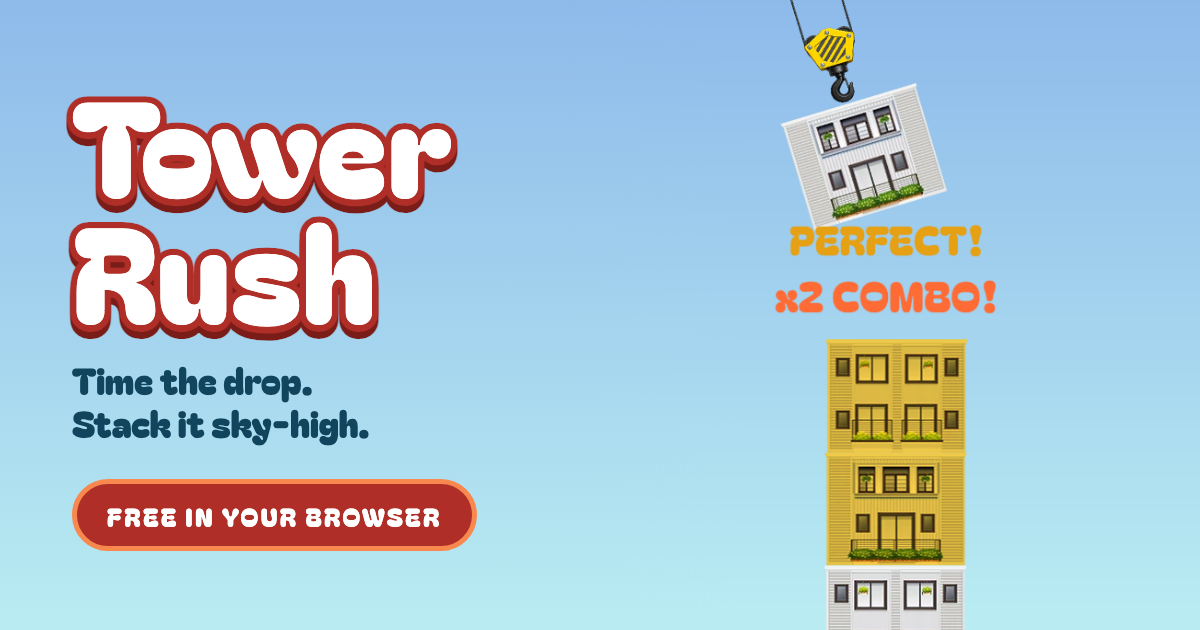
How it scores, straight from the game’s code:
- Perfect drop: the floor lands within 5 units of dead centre. It scores 25 times your current streak, so 25, then 50, then 75.
- Normal drop: 10 points, and the streak resets. If you were within 15 units of centre, it shows “SO CLOSE!”.
- Missed floor: if it falls off, you lose one of your three lives.
- Stability: a meter that fills as you build badly. An off-centre drop adds up to 10 depending on how far off it was (near misses add nothing), a missed floor adds 15, and a perfect drop takes 15 off. At 100 the tower collapses and the run is over, lives or not.
- Every 10 floors: stability is halved, and if that 10th floor was a perfect drop you get a life back (three is the most you can hold).
- Speed: the swing stays the same for the first ten floors, then slowly speeds up.
Where it differs from Tower Bloxx: there’s no city mode, no residents and no roof. It’s the quick-game half only, an endless tower with a score. If the city puzzle was what you loved, Tower Rush won’t scratch that.
Tips that carry over
These come from how Tower Rush scores, but the same habits help in any crane-and-drop game.
- Watch a full swing before the first drop. The timing only makes sense once you’ve seen where the hook turns round.
- Drop when the floor is over the centre, not when it looks close. In Tower Rush the perfect window is tiny, and a near miss scores the same 10 as a sloppy drop.
- Protect the streak. A perfect drop is worth 25 times the streak, so the fifth perfect in a row is worth five times the first.
- Don’t panic-tap after a bad drop. A missed floor costs a life and stability at once. One slow, careful drop to restart a streak is worth more than two quick ones.
- Aim for a perfect on every tenth floor. It’s the only way to win a life back, and the milestone halves stability either way.
- Bank the easy floors. The first ten don’t speed up, so that’s where to build a streak and keep the stability meter low before it gets harder.
If you came looking for the game from your old Nokia, I hope that settles it: Tower Bloxx, also City Bloxx. If you want that crane-and-drop feeling again today, Tower Rush is free to play in your browser.