Mini Golf Tips and Tricks: Bank Shots, Pace, Aim
The mini golf tips that save the most strokes: choose the pace before the line, so the ball reaches the cup slowly enough to drop. Aim bank shots at the cup’s mirror image behind the wall, with a little extra pace for the bounce. Read the slope, because the ball breaks away from the high side and most as it slows. And know when to lay up instead of going for it. They work on a real course and on a screen.
Most mini golf advice boils down to “hit it softer”, which is true but doesn’t help much when the ball is sitting behind a windmill. I make a mini golf game, Toon Golf, and building its physics taught me a lot about why putts miss, so I’ll use it for examples near the end.
These are rules of thumb, not laws. Every course has a hole that breaks them.
Pace beats line
A ball can roll straight over the middle of the cup and still not drop. If it’s moving too fast, it skips across or catches the rim and spins out.
The University of Bristol recently published research on the “lip out”, and the advice from it is simple: aim as close to the centre of the hole as you can, and arrive at the rim with little speed. A slow ball has just enough momentum to tip in. A fast one has enough to ride the rim and come back out.
Golf instruction says the same about longer putts. Kellie Stenzel, writing in GOLF’s tips on reading greens, puts controlling distance and speed ahead of perfecting the line on mid-to-long putts.
What that means on a mini golf hole:
- Pick a speed first, then a line. Decide where you want the ball to stop if it misses, and hit it to stop there.
- Aim to finish just past the cup, not well past it. A ball dying at the hole has the best chance of dropping.
How to aim a bank shot
Bank shots are less mysterious than they look. Elev8 Fun’s guide to playing the angles starts from the basic rule: the angle the ball hits a wall at equals the angle it leaves at.
To use it:
- Find the spot on the wall, not the cup. Picture the cup reflected through the wall, as if the wall were a mirror and the cup sat the same distance behind it. Aim straight at that reflected cup. Where your line crosses the wall is the spot to hit.
- Look along the line from behind the ball. It’s much easier to judge the angle in and out from there than from the side.
- Commit to the spot. Don’t drift back toward the cup as you putt.
Real walls aren’t perfect mirrors
The mirror trick assumes the wall gives back all the pace it was given. As a rule of thumb, allow a little extra for the bounce, and if a bank comes up short, add pace next time rather than changing the line. Better still, hit one test bank early in the round and watch where it actually goes.
Reading slopes, sand and obstacles
Before you putt, walk the hole. The GOLF article suggests walking past the hole on your way to the ball, so you see the slope from more than one side, and asking whether the putt is uphill, flat or downhill first. That decides how long your stroke should be: longer uphill, shorter and more controlled downhill.
Two more from the same piece that work on carpet:
- The ball breaks away from the high side. Look a few feet either side of your line and ask which side is higher.
- It breaks most as it slows down. The last few feet near the cup matter most, which is another reason to arrive slowly and allow a bit more break than you think.
Treat sand or rough patches as speed-eaters rather than slopes. Either go around them or hit through with more pace than you’d guess. For obstacles, Elev8 Fun’s advice is to bounce around an obstacle at an angle rather than trying to thread a narrow gap head-on.
When to go for it and when to lay up
Every hole has a heroic line and a safe one. Go for the heroic line when missing it still leaves you a short putt. Lay up when missing it means water, a drop, or bouncing back to the tee.
A good test: if this goes wrong, where does the ball end up? If the answer is “somewhere I can still two-putt”, go for it. If it’s “back behind the windmill”, play it safe and set up an easy second putt.
How to get a hole in one in mini golf
There’s no secret, but a few things raise the odds:
- If the straight line is blocked, look for one clean bank. A single bank you’ve aimed with the mirror trick is far more repeatable than two.
- Use pace that would stop just past the cup. A firm putt that’s on line can still rim out.
Moving obstacles: time the gap
Windmills, swinging gates and sliding blocks are timing problems, not aiming problems. Set your line and speed, then watch the obstacle cycle a couple of times. Find the moment it opens and count how long the ball needs to get there. Then putt that much earlier.
If the gap is tight, a little more pace means less time in the danger zone, but the ball still has to stop at the cup.
The same tips in digital mini golf
On a screen, the putter becomes a gesture. In Toon Golf, as in most drag-to-putt games, you drag back from the ball and let go: how far you drag sets the power and the direction sets the line. GamePigeon, the iMessage games pack, has a mini golf game you can play with friends in a chat, and it’s free with in-app purchases.
Everything above still applies, with a few changes:
- Pace is your drag length. Find what a short, medium and full drag do on a flat hole and remember them.
- Aim lines help with direction, not speed. If a game draws a line, treat it as “which way” and judge the stopping point yourself, unless it clearly shows it.
- Walls can be learned exactly. Toon Golf’s physics is deterministic, so a wall takes the same pace off every time. Once you’ve learned it, you can trust it in a way you can’t quite trust a real rail.
Practise in Toon Golf
Toon Golf is the free mini golf game I make. It runs in the browser on a phone or a computer, with no download. You drag back from the ball and let go. A drag of 190 pixels is full power, and anything under 14 does nothing, so a stray tap won’t putt. The aim line follows the predicted roll through one bounce and draws about four fifths of it, with no marker for where the ball stops. That’s on purpose: it tells you which way and roughly how hard, and pace is left to you.
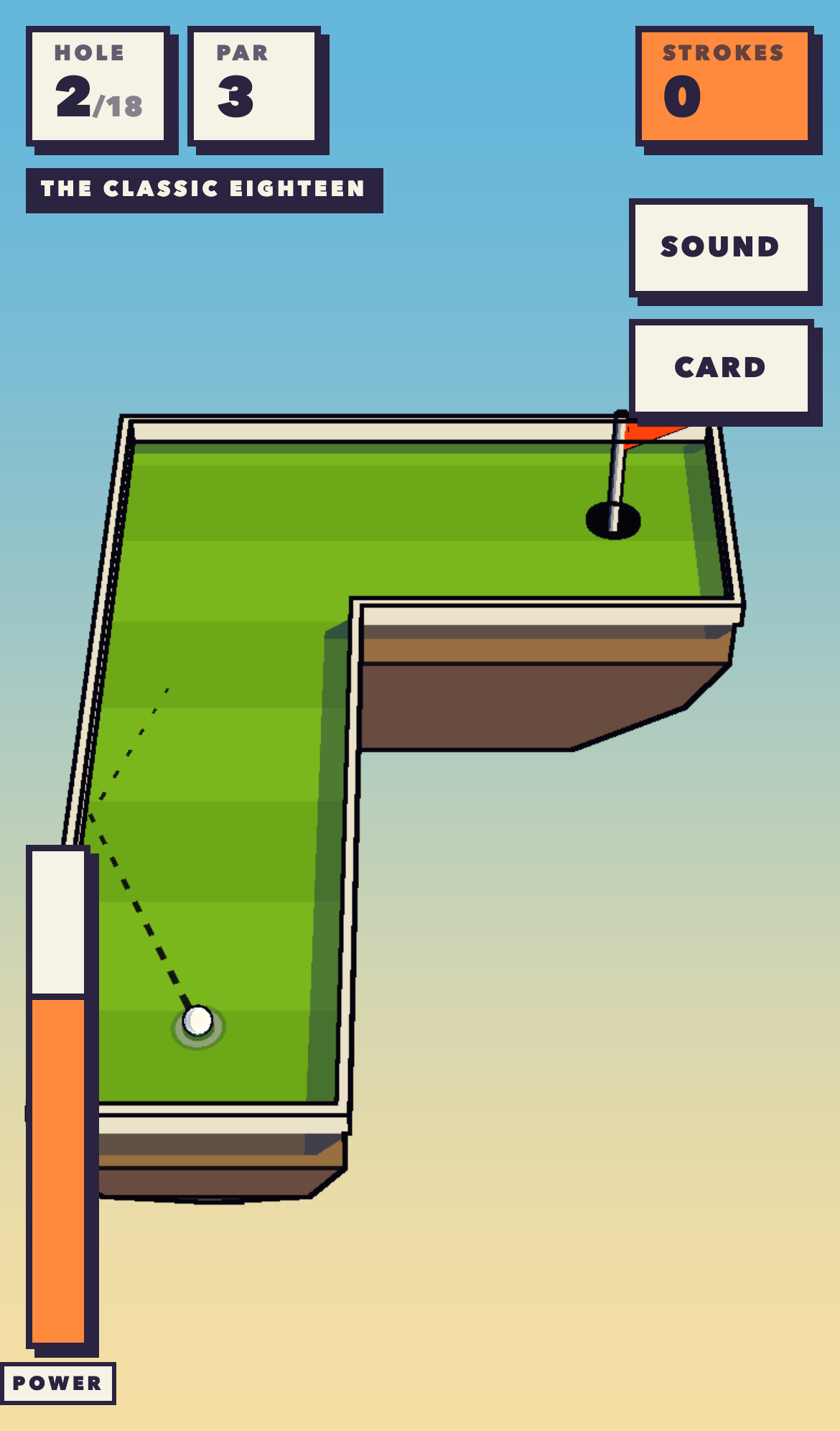
How the game teaches each skill:
- Pace: the cup only takes a ball that’s moving slowly, at about a fifth of full-power speed. Anything faster rims out, keeps most of its speed and gets knocked off line.
- Bank shots: walls reflect like the angle rule says, but keep only 72% of the speed going straight into them. Bumpers are the exception and send the ball out faster than it came in.
- Slopes and sand: slope zones push the ball the way their arrows point. Sand slows it more than four times as hard as the green, and ice barely slows it at all.
- Laying up: water costs a stroke and puts you back where you hit from. A pit costs no stroke but sends you back to the tee, which on a long hole is worse.
- Timing: moving blocks slide across the hole on a fixed cycle.
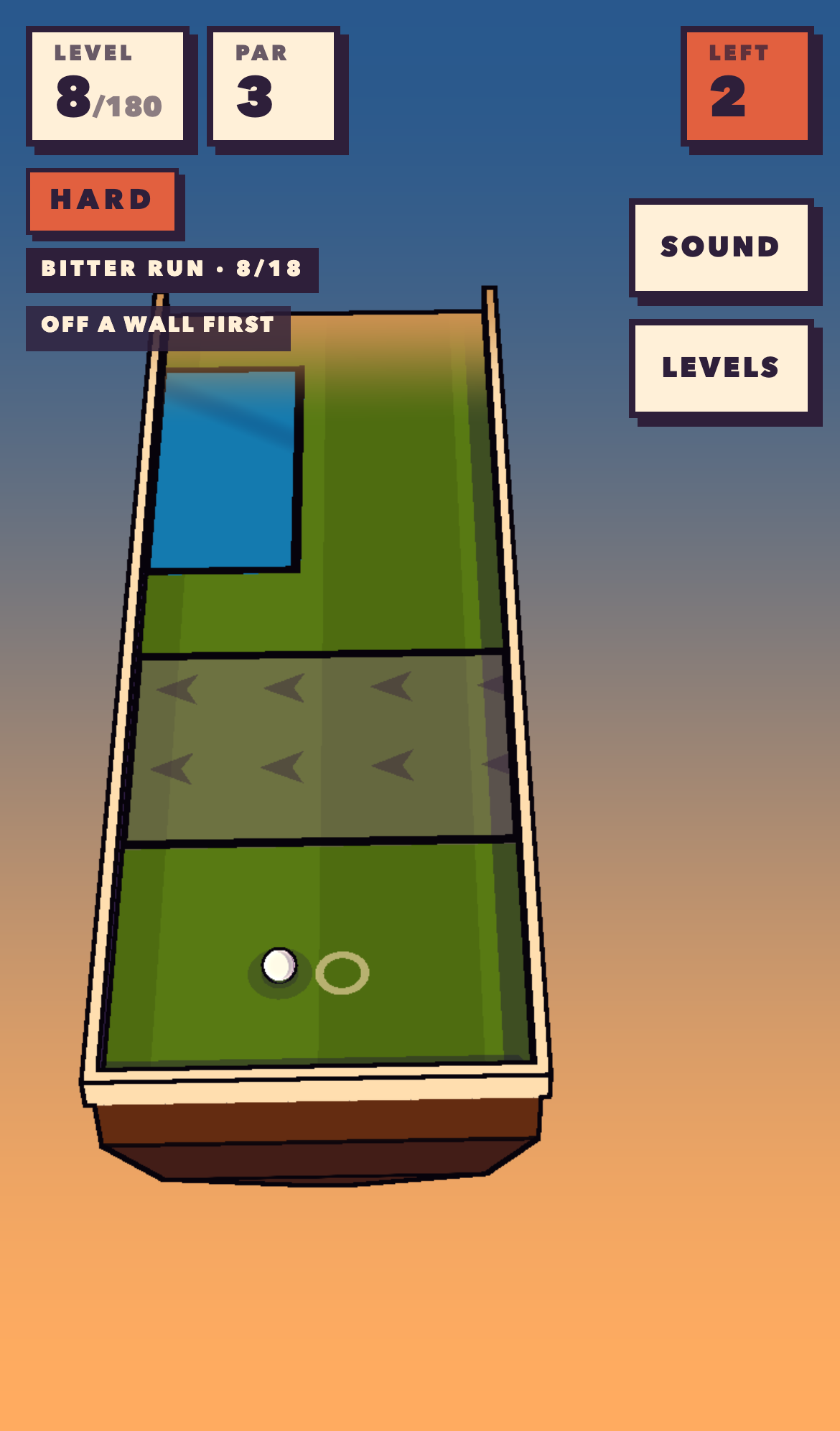
There are 180 levels across ten courses of 18, plus The Classic Eighteen, a handmade round you can play on its own. Roughly every fourth level is Hard and every eleventh is Brutal. Those carry extra rules, and past the halfway mark ordinary levels pick them up too. There are seven: a stroke cap, a gate to roll through, no touching the rails, off a wall first, one life in the water, faster moving blocks, and a clock, which only Brutal levels get. Some holes are fogged, so you only see the far end once the ball gets there. Every level is built the same way for everyone, so level 47 on your phone is level 47 on mine.
The honest limit: it’s a screen, not a putter, and it won’t teach you the quirks of your local course’s rails. What it will do is drill pace and bank angles until they’re habits.
If you want somewhere to practise bank shots and pace between rounds, Toon Golf is free to play in your browser.