Black Hole Paper Game Rules: How to Play
Black Hole is a two-player game you play with a sheet of paper and two pens. Draw a triangle of 21 circles, then take turns writing your numbers 1 to 10, in order, into empty circles. When all twenty are placed, the one empty circle is the black hole: it swallows every circle touching it, each player adds up only their own swallowed numbers, and the lower total wins.
That’s the whole game, and I make a browser version of it, Black Hole. This post covers the rules as you’d play them on paper, a worked example, the variants people play, and where to play it online if you don’t have a pen handy.
What you need
- A sheet of paper.
- Two pens in different colours, one per player. If you only have one pen, circle one player’s numbers.
- A triangle of 21 circles: six rows, with one circle at the top, two under it, and so on down to six on the bottom row.
          ○
         ○ ○
        ○ ○ ○
       ○ ○ ○ ○
      ○ ○ ○ ○ ○
     ○ ○ ○ ○ ○ ○
Each player owns the numbers 1 to 10, once each.
How a turn works
Players take turns writing one number in any empty circle. You both play the same number before either of you moves on: the first player writes their 1, the second player writes their 1, the first player writes their 2, the second their 2, and so on up to 10.
You have to play your numbers in order. You can’t save your 1 for later or play your 10 early. The only choice on a turn is where the number goes.
Two players times ten numbers is twenty placements, and there are twenty-one circles. So when both players have written their 10, exactly one circle is still empty. That’s the black hole.
The black hole and scoring
The empty circle swallows every circle that touches it. In this triangle a circle can have up to six neighbours: one on each side in its own row, two in the row above and two in the row below. Circles on the edge of the triangle have fewer.
Each player adds up only their own numbers that got swallowed. Your opponent’s numbers around the hole don’t count against you. The lower total wins. Equal totals are a draw.
Why “higher total left over” is the same rule
Some write-ups, like Math with Bad Drawings, put it the other way round: whoever has the greater sum left on the board wins. That’s the same game. Every player writes 1 through 10, and 1 + 2 + … + 10 = 55, so your numbers always add up to 55. Whatever the hole doesn’t swallow is still on the board, so your surviving total is always 55 minus your swallowed total. Losing less to the hole and keeping more on the board are one and the same thing.
A worked example
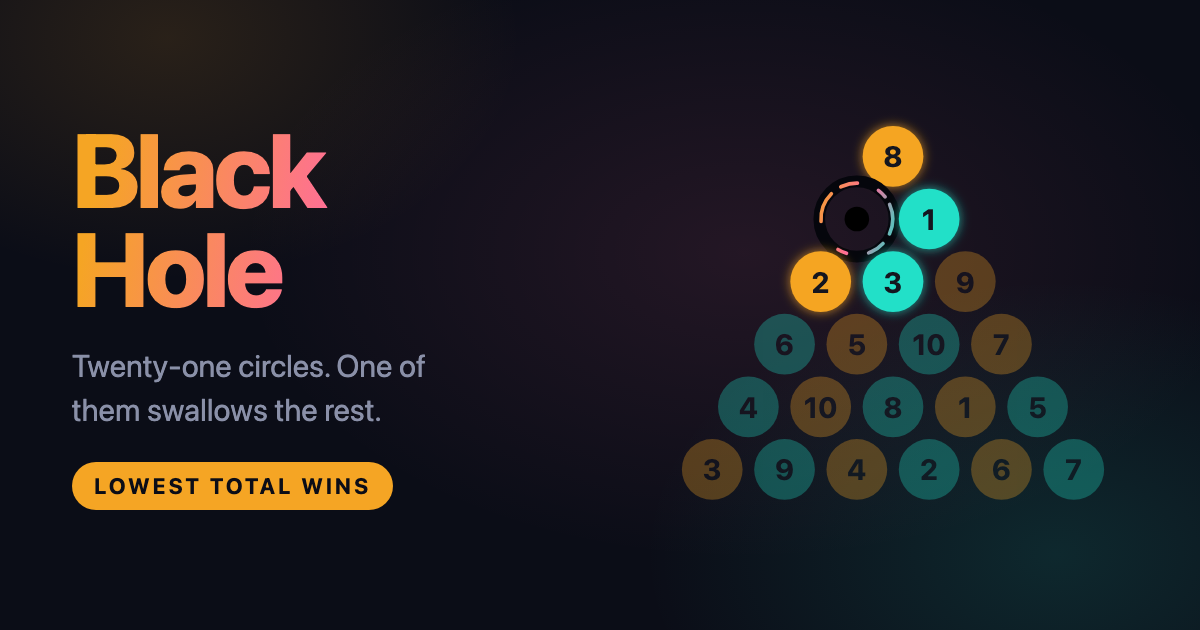
This is the example from my game’s own How to Play screen. The circle left empty is the left one in the second row. Four circles touch it: amber’s 8 at the top, cyan’s 1 beside it, and amber’s 2 and cyan’s 3 in the row below. Amber loses 8 + 2 = 10 and cyan loses 1 + 3 = 4, so cyan wins, 4 to 10. None of the other sixteen numbers count, however big they are.
The nestorgames rulebook has an endgame example of its own. There the hole is the last circle on the right of the fifth row. Above it is a red 3, to its left a blue 1, and below it a blue 10 and a red 5. Red loses 3 + 5 = 8, blue loses 1 + 10 = 11, and red wins 8 to 11. Blue’s 10 ended up right under the hole, and that alone decided it.
Variants
- Any order. The nestorgames rulebook lists a variant where numbers don’t have to be played in ascending order, so you choose both the number and the spot.
- Random draw. The same rulebook’s second variant, credited to Néstor Romeral Andrés: each player shuffles their tiles face down and draws them at random during the game. On paper, you could write 1 to 10 on scraps and draw them from a cup.
- Smaller or bigger boards. Math with Bad Drawings suggests dropping the bottom row for a quick game of 15 circles with the numbers 1 to 7 each, or adding three rows for 45 circles and 1 to 22 each. The arithmetic works the same way: two players fill all but one circle.
- Three players. The Tabletop Family adds a seventh row and has each player write only 1 to 9. That’s 28 circles and 27 placements, so one circle is still left empty.
- Check an app’s scoring. Not every version scores it the same way. The App Store listing for Black Hole Puzzle says the player with the highest total wins. If that’s the total left on the board, it’s the 55-minus rule above. Either way, read an app’s own rules before assuming.
A little strategy
The one hint my game gives is that numbers you cluster together are harder to punish. A hole can only touch a cluster along its edge, so it reaches fewer of your big numbers when they’re packed than when they’re spread out.
It’s a starting point, not a solution. Clustering tells your opponent where you’re vulnerable, the low numbers you scatter early matter more than they seem to, and the last few placements are usually where the game is won or lost. By then there are only a handful of empty circles, and every one of them is a possible hole. Count each one: who would lose what if that circle were the one left over?
There’s also a question of who goes first. When I had my game’s hardest computer setting play itself 60 times, 45 games were draws and the second player never won. That’s one engine against itself, and 60 games is a small sample, so it isn’t a proof of anything. It’s enough that I didn’t want a single game to decide a match, so in my version a match is two legs with the opening swapped, and the lower total across both legs wins.
Where the game comes from
The 2013 nestorgames board edition credits Wal Joris as the designer, and the game appears in his book 100 Strategic Games for Pen and Paper, according to Math with Bad Drawings. Whether it started there or was already being played on paper before that is hard to pin down.
Playing Black Hole online
Paper is still the easiest way: draw the triangle, hand over a pen, and you’re playing. If you want a computer opponent, or your opponent isn’t in the room, these are the options I could find and check.
My browser version
My version plays in the browser, with nothing to install, three ways:
- Against the computer, at Easy, Medium or Hard.
- Two players on one device, passing it back and forth.
- Online with a friend. One of you starts a game and gets a five-character room code; the other types the code in or opens the share link. If someone loses signal, they have 60 seconds to come back before that leg is forfeited.
Every game is a two-leg match with the opening swapped, as above. It uses the standard rules only: 21 circles, numbers in order, lower total wins. None of the variants are in it.
Other versions
- Black Hole: Strategy on the App Store, for iPhone and iPad, lets you play the AI or a friend, with lowest score winning. It’s free with ads, and a paid upgrade removes them.
- The Black Hole game by Juha-Matti Santala is a browser version for two people sharing one screen. He wrote about building it.
- Black Hole Puzzle on the App Store has real-time multiplayer, though as noted above its listing describes the scoring as highest total wins.
If you’d rather not draw the triangle, Black Hole is free to play in your browser.